Development by Davis

Headlines

miércoles, 16 de enero de 2013

Development by Davis: “What artists want in software: An ode to Dream Studio” plus 2 more

Development by Davis: “What artists want in software: An ode to Dream Studio” plus 2 more


What artists want in software: An ode to Dream Studio

Posted: 16 Jan 2013 01:00 AM PST

open source why

I am an artist and the sole maintainer of Dream Studio, a free and open source creative system. Though most of the software is maintained by others who maintain their own Ubuntu PPAs, which are included with Dream Studio by default (which is, itself, based on standard desktop Ubuntu), I create the default themes and overall look of Dream Studio, package the various multimedia categories, create the installer disc (and Dream Studio for Ubuntu), and write a couple of the programs and scripts included with the distribution.

I've been a professional musician for 12 years and recording music for 17. I've also been creating graphics like band logos, concert posters, T-shirt designs, and CD packages for 10 years, and making music videos for the last 5. I feel I have a pretty good idea of what artists want in a creative studio, and because I believe in open source, I want to share the tools I use personally with the whole world, as so much software has been shared with me.

read more

Collaborating for a cure: Cancer, medical records, and an open philosophy

Posted: 15 Jan 2013 11:00 PM PST

rx open source

Salvatore Iaconesi has brain cancer. And he's doing something about it that most don't: taking it into his own hands. And the hands of hundreds of others, as they all work together to cure his disease (and offer hope to others).

The project is called The Cure, and at it's apex as many as 200 people—doctors, surgeons, traditional practitioners, shamans, artists, designers, hackers, software engineers, ex-patients—were working simultaneously (and voluntarily) to contact people, arrange appointments, send out documentation and ask for opinions, and then collect all of the resulting information and classify it. They used pre-exisiting software tools and even produced and assembled some themselves.

Today, Salvatore uses all of this critical information to form a personal strategy, which he says is showing positive results. In this interview find out how open source software and concepts power this fantastic exploration into self-managed therapy.

read more

Android Developer Story: Smule

Posted: 15 Jan 2013 11:22 AM PST

Check out our latest Android developer story, this one from Smule, creators of AutoRap, Magic Piano, and Songify.

In this short video, the Smule team talks about their experiences launching on Android, the explosive global growth they've seen on Google Play, and some of the techniques they use to market and monetize their products effectively across the world.


Visit the Spotlight pages in the Android Developers site to see our growing list of developer stories.

martes, 15 de enero de 2013

Development by Davis: “Could open source build a jetliner?” plus 2 more

Development by Davis: “Could open source build a jetliner?” plus 2 more


Could open source build a jetliner?

Posted: 14 Jan 2013 09:40 PM PST

open source jet

I know this might sound like an odd question. It first came up in a conversation I had with Gary Hamel, the eminent business thinker and one of the first people to recognize the importance of distributed co-creation and that it will change management in the 21st century. We were discussing how the power of participation could replace traditional management for purposes of coordination and what it's limits might be. We ended up using the analogy of building a jetliner as our best example of where tight coordination is required. This question has been nagging on my mind ever since.

read more

Software Wars: A film about FOSS, collaboration, and software freedom

Posted: 14 Jan 2013 11:00 PM PST

open film production

The impact of software has changed our lives. But the average technology consumer doesn't realize how important having access to source code and an open development process is to our overall freedom. Keith Curtis, a University of Michigan dropout turned decade-long programmer at Microsoft turned open source advocate, wants to change that. 

read more

Evolution of Renderscript Performance

Posted: 14 Jan 2013 11:39 AM PST

Posted by R. Jason Sams, Android Renderscript Tech Lead

It's been a year since the last blog post on Renderscript, and with the release of Android 4.2, it's a good time to talk about the performance work that we've done since then. One of the major goals of this past year was to improve the performance of common image-processing operations with Renderscript.

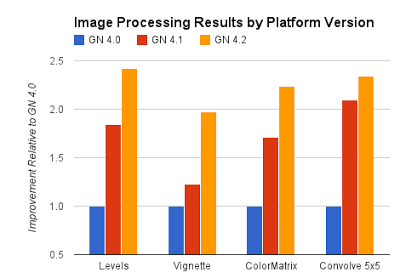
Renderscipt optimizations chart

Figure 1. Renderscript image-processing benchmarks run on different Android platform versions (Android 4.0, 4.1, and 4.2) in CPU only on a Galaxy Nexus device.


Figure 2. Renderscript image-processing benchmarks comparing operations run with GPU + CPU to those run in CPU only on the same Nexus 10 device.

When you set out to improve performance, the first task is to measure it. To do this, we built a image-processing benchmark suite. The tests measure how long it takes to apply a given image processing operation to a roughly 1.7 million pixel bitmap. We then ran the benchmark using the same APK on the Galaxy Nexus and normalized the results from Ice Cream Sandwich to 1.0.

We made a few major improvements between ICS and Jelly Bean, which significantly reduced the overhead of short scripts as well as the cost of getting elements out of allocations. Going from Android 4.1 to Android 4.2, we added a number of performance improvements to the math library. Our hardware partners also made major contributions; ARM in particular provided numerous compiler improvements which greatly improved our ability to generate vector code.

Android 4.2 introduced another much more important change: For the first time on any mobile platform. we can use the GPU as a compute device. When run on a device that supports GPU compute, that same benchmark APK will run on the GPU. The chart in Figure 2 is normalized to the same basis as Figure 1.

The Cortex A15 in Nexus 10 is a very good CPU. However, that doesn't mean we should leave resources idle. The Mali T604 is a very flexible and capable compute device capable of executing a large subset of RenderScript functionality. The green bar in Figure 2 shows what we can do when the Mali is enabled for RS compute. No effort is required on an app developer's part to enable this acceleration; the device will inspect each script and decide which processor to run things automatically. It's important to note that some scripts can't be run on the GPU, and such scripts will automatically run on the CPU.

The best part is it doesn't end here. Performance work is an ongoing effort. RenderScript performance in applications will continue to improve over time as we continue to improve the platform.

To learn more about using Renderscript, see the Renderscript Computation developer's guide.

lunes, 14 de enero de 2013

Development by Davis: “How the mobile revolution is challenging open source user interfaces” plus 1 more

Development by Davis: “How the mobile revolution is challenging open source user interfaces” plus 1 more


How the mobile revolution is challenging open source user interfaces

Posted: 14 Jan 2013 01:00 AM PST

mobile mashup

In the past couple of years, a powerful paradigm shift has occurred in user experience (UX) design. UX designers used to focus on desktop users but now, mobile devices and mobile users are at the center of attention. The evidence for the importance of this paradigm shift is stifling: Morgan Stanley predicts that by 2014, mobile users will exceed desktop users. Google's executive chairman Eric Schmidt says that "if you don't have a mobile strategy, you don't have a future strategy."

read more

A final lesson on teaching open source NoSQL databases

Posted: 13 Jan 2013 11:00 PM PST

education key

In two recent posts, we described a set of tutorial sessions teaching open source NoSQL databases at SUNY Albany.

read more

viernes, 11 de enero de 2013

Development by Davis: “Ouya gaming contest offers $45,000 in prizes with judge Felicia Day and others” plus 1 more

Development by Davis: “Ouya gaming contest offers $45,000 in prizes with judge Felicia Day and others” plus 1 more


Ouya gaming contest offers $45,000 in prizes with judge Felicia Day and others

Posted: 11 Jan 2013 01:00 AM PST

Create Jam

Last fall, 63,416 people donated $8.5 million to help the creation of an Android-based, open source gaming console. Ouya's Kickstarter project had donations of $95 or more from 58,211 people who wanted the first shot at this console that didn't yet exist. (If you weren't one of them, you can pre-order them now at ouya.tv.)

read more

Top 10 FOSS issues of 2012

Posted: 10 Jan 2013 11:00 PM PST

foss lawyers

The year 2012 had many important FOSS legal developments which reflects the continued increase in FOSS use. FOSS projects have increased from 600,000 in 2010 to 900,000 by December 2012. In addition, a Dr. Dobbs' survey in the third quarter of 2012 stated that more than 90% of developers are using FOSS in two of the most rapidly growing areas, cloud computing and mobile computing.

Continuing the tradition of looking back over the top ten legal developments in FOSS, my selection of the top ten issues for 2012 are as follows.

read more