Development by Davis

Headlines

jueves, 10 de enero de 2013

Development by Davis: “How open source is driving the future of cloud computing” plus 4 more

Development by Davis: “How open source is driving the future of cloud computing” plus 4 more


How open source is driving the future of cloud computing

Posted: 10 Jan 2013 12:00 AM PST

In 1998, Amartya Sen was awarded the Nobel Prize for Economics. The lecture he gave, titled "The Possibility of Social Choice," succinctly captured both the subject of his work (generalizing economic theory to cover social groups of disparate actors rather than just individuals or corporations) and his irrepressible sense of humor (because the generalization applied to Arrow's Impossibility Theorem). Sen's crucial insight (for me) is this (emphasis mine):

read more

This posting includes an audio/video/photo media file: Download Now

LISA 2012: What the USENIX Large Installation System Administration conference has going for it

Posted: 09 Jan 2013 11:00 PM PST

event report

I recently came back from the USENIX Large Installation System Administration (LISA) conference held in San Diego, California, and it was an interesting experience.

read more

For your OSS image building and sharing pleasure … meet VM Depot from MS Open Tech

Posted: 08 Jan 2013 11:00 PM PST

By Gianugo Rabellino
Senior Director Open Source Communities
Microsoft Open Technologies, Inc.

As I write this, I'm exploring the public preview of VM Depot, a new service from Microsoft Open Technologies, Inc. VM Depot is a community-driven catalog of open source virtual machine images for Windows Azure. On VM Depot the community can build, deploy and share their favorite Linux configuration, create custom open source stacks, work with others and build new architectures for the cloud that leverage the openness and flexibility of the Windows Azure platform.

The preview launch of VM Depot today is an introduction of things to come: you can already easily deploy different Linux-based virtual machines that include custom and curated installations and configurations. (We have the latest, full-fledged distributions of Debian, Alt Linux and Mageia for your hacking pleasure.) You can comment on them. You can rate them. And, what's more, you can remix them to your liking and possibly share the results with other members of the community. Or why don't you go ahead and just create a new one from scratch with your favorite software? For ultimate speed, you can quickly deploy images already customized for specific business scenarios. All this is just a few clicks away, completely free of charge and just waiting for your input to make it better. To learn more, see Getting Started with VM Depot.

VM Depot is another illustration of how the Azure platform is effectively open. As complex as it may seem, VM Depot was relatively easy to build as it relies exclusively on published Azure APIs. As we explore the meaning of openness and interoperability of cloud platforms, I can now say that Windows Azure is at the forefront of the debate and provides compelling proof that documented APIs can do wonders to enable building amazing new applications that leverage the cloud.

Some days you can't help smiling. I had a big smile on my face back in June when Microsoft announced it was making preconfigured Linux images available in Windows Azure gallery and today I have another reason to be happy as I see how Microsoft Open Technologies is helping open source communities work even more collaboratively with the Windows Azure platform.

VM Depot wouldn't have been possible without the support of a number of partners who have contributed images and packages for this preview launch, including Alt Linux, Basho, Bitnami and Hupstream. Here what they have to say about VM Depot:

"Ease of deployment is one of the key discussions we have with all of the companies leveraging Riak for their highly-available, scalable data storage needs. The VM Depot indicates that Microsoft Open Technologies is dedicated to supporting the needs of today's enterprise with the Windows Azure Platform" - Tyler Hannan, Director of Technical Marketing, Basho Technologies, Inc.

"The launch of Azure Virtual Images and now the VM Depot demonstrate that Microsoft is serious about building out its cloud computing platform. We are thrilled to be a part of this new marketplace, which simplifies deployment of the top open source applications to the enterprise-ready Azure platform, taking Windows Azure to a whole new level." – Erica Brescia, CEO of BitRock, developers of Bitnami

"The demand for cloud computing is there, and Hupstream had the skills to adapt a distribution to the specifics of cloud computing, and provide support as needed. We also wanted to make Debian and Mageia more accessible, and cloud platforms are the simplest way to get started. This was also an opportunity to establish a conversation between actors that traditionally shun each other. Notably, we had excellent collaboration with Microsoft engineers and other community members, while working on a common goal: expanding the reach of developers with Linux." – Romain d'Alverny, Managing Partner & Engineer at hupstream

I have been doing a fair amount of traveling for MS Open Tech lately where I've met a number of great people from the open source community. After a wonderful holiday break, we're off to an exciting and busy New Year. I know I will use every free moment this month to peek at the VM Depot dashboard and see our latest creation take its first baby steps. Expect more in the upcoming weeks and please help us make VM Depot the best place for open source communities to work together and build shared images for the cloud. See you there.

miércoles, 9 de enero de 2013

Development by Davis: “Want to understand open source? Live with its developers” plus 2 more

Development by Davis: “Want to understand open source? Live with its developers” plus 2 more


Want to understand open source? Live with its developers

Posted: 09 Jan 2013 01:00 AM PST

Open source beliefs

Let's say you want to understand what makes free and open source software (FOSS) so vital today—and what makes those who write it so committed to their difficult work. How would you do this?

read more

Abolishing patents: Too soon or too late?

Posted: 08 Jan 2013 11:00 PM PST

patent stop sign

"Patents are here to stay." This is the sort of statement that makes me uneasy. I guess in the 17th century the common wisdom was "slavery is here to stay." In the 18th century giving voting rights to women seemed absurd and foreseeing open borders between France and German was crazy talk in 1945. At a certain point, fortunately, those things changed for the better. Is it time to change the common wisdom on patents as well? Is the time ripe—will it ever be?—to utter the frightening word abolition? I do not have the privilege to know the answer, but I regard the question as a legitimate one. According to some patent experts, however, questioning the very existence of patents seems blasphemous.

read more

Verifying Back-End Calls from Android Apps

Posted: 08 Jan 2013 11:32 AM PST

Posted by Tim Bray

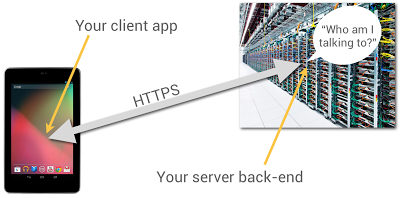
Most Android apps have some sort of server-side back end, to persist and share data. Even the most basic game needs to remember its players' high scores. When you're building your back end, one problem you have to solve is how the back-end code knows what app it's talking to and who the person using it is.

You probably have HTTP endpoints for communicating with your client apps, but how can the server-side code be sure who's sending messages to it? After all, anyone can send HTTP POST requests from anywhere; could they impersonate your users if they could guess their identities?

It's really user-unfriendly to ask people to type in usernames and passwords on mobile devices. In particular, if someone has installed your app and given it permission to use the Internet and know your identity, they shouldn't be pestered any more.

It turns out that Google Play services, now available on every compatible device running Android release 2.2 or higher, offers a good solution to this problem, based on the use of Google Accounts.

Summary

Doing this is a multi-step process, which I'll outline in full, but here's the short version: You use the GoogleAuthUtil class, available through Google Play services, to retrieve a string called an "ID Token". You send the token to your back end and your back end can use it to quickly and cheaply verify which app sent it and who was using the app.

This capability is built into Google facilities such as App Engine's new Cloud Endpoints feature, which bakes app/back-end identity into a simple programming model.

Now let's get to the details.

App Registration

You're going to have to use the Google API Console quite a bit in this process. You'll need to make a new project for this purpose; while you can give it a nice human-readable name and graphical branding, it turns out that those resources aren't used in this particular scenario.

You can also authorize this project to access a large number of different Google APIs; but once again, you don't need to in this scenario.

You should give serious thought to the people you authorize as members of the project, since these are important administrative roles.

Make Client IDs

You'll need to make two different OAuth 2.0 "Client IDs" for your project. The first one is a "Client ID for Web applications". Once again, you can ignore all the labeling and branding stuff, you'll just need the Client-ID string, which will look something like 9414861317621.apps.googleusercontent.com.

Now you'll need to make another Client ID for your Android app. To do this, you'll need to provide two pieces of information: your app's package name and cert signature. The package name is just the Java-style reverse-DNS, as given in the top-level "package" attribute in your AndroidManifest.xml, for example com.example.identity.

To get your app's cert signature, use the following shell command:

$ keytool -exportcert -alias <your-key-name> -keystore <your-key-store-file> -v -list

Copy the octets labeled "SHA1", paste them into the Developer Console field, and create your app's Client ID. Once again, all you'll really need from the readout is the Client-ID string.

In Your Android App

You'll need to call the Google Play services GoogleAuthUtil class to get an ID token; the procedure is as described in Obtaining an Access Token. There's one extra bit of magic: the value of the scope argument to the getToken(email, scope) method. It has to be the string audience:server:client_id:X, where X is the Client ID of for the Web app, as described above. If our Client ID were the example value given above, the value of the scope argument would be audience:server:client_id:9414861317621.apps.googleusercontent.com.

Magic Happens

Normally, when you ask for an OAuth token, the person using the device sees a challenge, asking them if it's OK to use their identity to get at some resource or other. But in this case, the system looks at the server-side Client ID in your scope argument, notices that it's in the same project as your Android app, and gives you the token without pestering the user; they've already agreed to a relationship with you, the developer who controls that project.

Send the Token

When you're ready to start talking to your server back end, you need to send the token string to it. The best way to do this is in the body of an POST message; you could put it in a URL parameter, but they're often logged. You absolutely must use an HTTPS connection, to keep any men-in-the-middle from peeking at your token.

There's no particular reason for extra round-trips; if you're sending a game high score to your back end, just stick the ID Token string in as an extra argument.

Use the Token

When your server receives the token from your Android app, it's really important that you verify it. This requires two steps:

  1. Verify that it's really signed by Google.
  2. Verify that it's really meant for you.

Verify Signature

It turns out that this is signed using a Google public/private key pair, and Google publishes the public keys (which we change regularly) at www.googleapis.com/oauth2/v1/certs; go ahead and have a look.

You have to verify that the ID Token, which is actually a JSON Web Token, was signed with one of those certs. Fortunately, there are decent libraries around to do this; in this post, I'll give pointers for Java, Ruby, and PHP.

The libraries can cache the Google certs and only refresh them when required, so the verification is (almost always) a fast static call.

Verify Token Fields

It turns out that the ID Token has a JSON payload, and most libraries that validate the signatures also give it to you as a hash or dictionary or whatever. Thus, you can retrieve named fields, such as aud and cid and email.

First, you have to look at the field named aud and verify that it's identical to your Client ID, the string you included in the Android app's scope argument. Seriously, do not omit this step; if you don't verify the ID Token, then any other developer can spoof requests to your service.

Optionally, you can look at the field named cid and verify that it is identical to the Client ID of your Android app. By the way, you can have multiple different Android client apps, each with its own Client ID, in that top-level project.

Let's assume you've done all three of these things. Then, you know that:

  1. The token was issued by Google.
  2. The token was sent to a device that was being operated by the person identified in the payload's email field.

You also have high confidence that:

  1. The token was obtained by the Android app identified by the Client ID in the payload's cid field.

The Client ID only has "high confidence" because non-compatible or rooted Android devices may be able to tamper with that information. But they won't be able to fake the Google signature or the authentication of the device user to Google.

What's Next?

That's up to you. You know which person and app you're talking to, it's up to you what to do with that information.

Code Fragments

Here's a Java class that implements an ID-Token checker using the Google Java libraries:

import java.io.IOException;  import java.security.GeneralSecurityException;    import com.google.api.client.googleapis.auth.oauth2.GoogleIdToken;  import com.google.api.client.googleapis.auth.oauth2.GoogleIdTokenVerifier;  import com.google.api.client.http.javanet.NetHttpTransport;  import com.google.api.client.json.JsonFactory;  import com.google.api.client.json.gson.GsonFactory;    public class Checker {        private final List mClientIDs;      private final String mAudience;      private final GoogleIdTokenVerifier mVerifier;      private final JsonFactory mJFactory;      private String mProblem = "Verification failed. (Time-out?)";        public Checker(String[] clientIDs, String audience) {          mClientIDs = Arrays.asList(clientIDs);          mAudience = audience;          NetHttpTransport transport = new NetHttpTransport();          mJFactory = new GsonFactory();          mVerifier = new GoogleIdTokenVerifier(transport, mJFactory);      }        public GoogleIdToken.Payload check(String tokenString) {          GoogleIdToken.Payload payload = null;          try {              GoogleIdToken token = GoogleIdToken.parse(mJFactory, tokenString);              if (mVerifier.verify(token)) {                  GoogleIdToken.Payload tempPayload = token.getPayload();                  if (!tempPayload.getAudience().equals(mAudience))                      mProblem = "Audience mismatch";                  else if (!mClientIDs.contains(tempPayload.getIssuee()))                      mProblem = "Client ID mismatch";                  else                      payload = tempPayload;              }          } catch (GeneralSecurityException e) {              mProblem = "Security issue: " + e.getLocalizedMessage();          } catch (IOException e) {              mProblem = "Network problem: " + e.getLocalizedMessage();          }          return payload;      }        public String problem() {          return mProblem;      }  }

If you wanted to do this in Ruby, you'd want to install the google-id-token Ruby gem, and do something like this:

require 'google-id-token'  validator = GoogleIDToken::Validator.new  jwt = validator.check(token, required_audience, required_client_id)  if jwt    email = jwt['email']  else    report "Cannot validate: #{validator.problem}"  end

For PHP programmers, check out the Google APIs Client Library for PHP, in particular the function verifyIdToken in apiOAuth2.php.

martes, 8 de enero de 2013

Development by Davis: “A look back at open source creative tools in 2012” plus 5 more

Development by Davis: “A look back at open source creative tools in 2012” plus 5 more


A look back at open source creative tools in 2012

Posted: 07 Jan 2013 01:00 AM PST

open praire

For all of you free and open source creative tool fans out ther, plenty of exciting developments happened over the past year—and there's some pretty awesome new things in the pipeline for 2013 as well! Here's a sampling of the good news:

read more

What's your go-to note-taking app?

Posted: 08 Jan 2013 12:00 AM PST

pencils
What tool do you use to retain snippets of information?
Evernote
Tiddlywiki
Notational
Epistle
PNotes
ownCloud
SimpleNote
ScratchPad
Other

A good year starts off with good ideas. But, how do you remember them all, along with the related information that is helpful for making them into realities? There are a multitude of options, from simple notepads to more robust filing systems, and we all search for the one that's just right. So, beyond finding a tool that you can easily access from your smartphone, laptop, or tablet: What do you look for in the perfect note-taking app?

AMD Delivers Enhanced Gaming and Improved Application Performance with Latest Mobile and Desktop Graphics Technology

Posted: 07 Jan 2013 12:00 AM PST

AMD (NYSE: AMD) today launched the AMD Radeon™ HD 8000M Series of mobile graphics processing units (GPUs) set to deliver discrete graphics performance to a variety of notebook designs, including the incredibly portable ultrathin form factor. The AMD Radeon HD 8000M Series are the first notebook GPUs to be offere...

AMD Unveils Innovative New APUs and SoCs that Give Consumers a More Exciting and Immersive Experience

Posted: 07 Jan 2013 12:00 AM PST

AMD (NYSE: AMD), a leading provider of technology that enables visually-rich experiences for today's consumers, provided an early look at its new 2013 accelerated processing units (APUs) and announced a new OEM relationship with VIZIO. At an International Consumer Electronics Show (CES) event, AMD demonstrated w...

Industry Veteran Roy Taylor Joins AMD To Lead Global Channel Sales

Posted: 07 Jan 2013 12:00 AM PST

AMD (NYSE: AMD) announced today that Roy Taylor has joined the company as corporate vice president and head of Global Channel Sales, reporting to Senior Vice President and Chief Sales Officer John Byrne. In this role, Taylor will b...

A lesson from 2012: Open education brings power of knowledge to the masses

Posted: 07 Jan 2013 01:00 AM PST

open education resources

The end of 2012 is here and over time I think it will be considered a revolutionary moment for open education and open source. A tipping point. A seismic shift. The world has not seen this type of revolution since the early 1400s and the arrival of the printing press.

read more